
Premier League 2024/25 | Matchday 38 | Old Trafford, Manchester | 25 May 2025
The numbers look convincing on paper. Two goals, 2.95 xG, 67% possession, 25 shots to Villa’s six. Yet anyone watching Manchester United close out their 2024/25 Premier League season at Old Trafford was left with a nagging feeling — the kind that has followed Ruben Amorim’s side all year. They had every structural advantage imaginable and still needed a 76th-minute goal to break the deadlock. The result was right. The performance was not.
The Turning Point: Martínez and the Moment That Changed Everything
Emiliano Martínez handed United the game at 45+1′. Sprinting out to deny what appeared to be a clear goalscoring opportunity, the Villa goalkeeper clattered the onrushing attacker and was immediately shown red — a professional foul, last man, no debate. Marco Asensio was sacrificed at 45+4′ to bring on reserve ‘keeper Robin Olsen, and suddenly Unai Emery’s 4-2-3-1 was a ten-man shell operating without its first-choice goalkeeper for the entire second half.
This is the sort of gift that transforms a competitive match into a training exercise. For most teams at full tilt, playing 45 minutes against ten men and a back-up goalkeeper with a two-goal xG cushion would be a matter of when, not if. For Amorim’s United, it became a 31-minute wait.
Amorim’s Blunt Edge: The Editorial Verdict
Here is the uncomfortable truth about this version of Manchester United: Amorim’s football consistently struggles to land the decisive blow, even when the door is wide open. This was not a performance undermined by a resilient opponent or adverse circumstances. Villa were shorthanded, disorganised, and running on fumes. Yet United’s 3-4-2-1 — structured, disciplined, metronomically patient — generated 25 shots and converted just twice, with Diallo’s opener not arriving until the 76th minute.
Olsen’s heroics deserve acknowledgment. Eight saves in one half of football is an extraordinary individual effort, and Villa’s goals-prevented figure of 0.84 reflects how much he personally kept the margin respectable. But crediting the goalkeeper only papers over a deeper issue: United, with a numerical advantage and statistical stranglehold (88% pass accuracy, 605 total passes, 14 shots inside the box), should have put this to bed long before the 70-minute mark.
The 2.95 xG tells you the chances were there. The 76th-minute breakthrough tells you United couldn’t finish them.
How the Game Unfolded
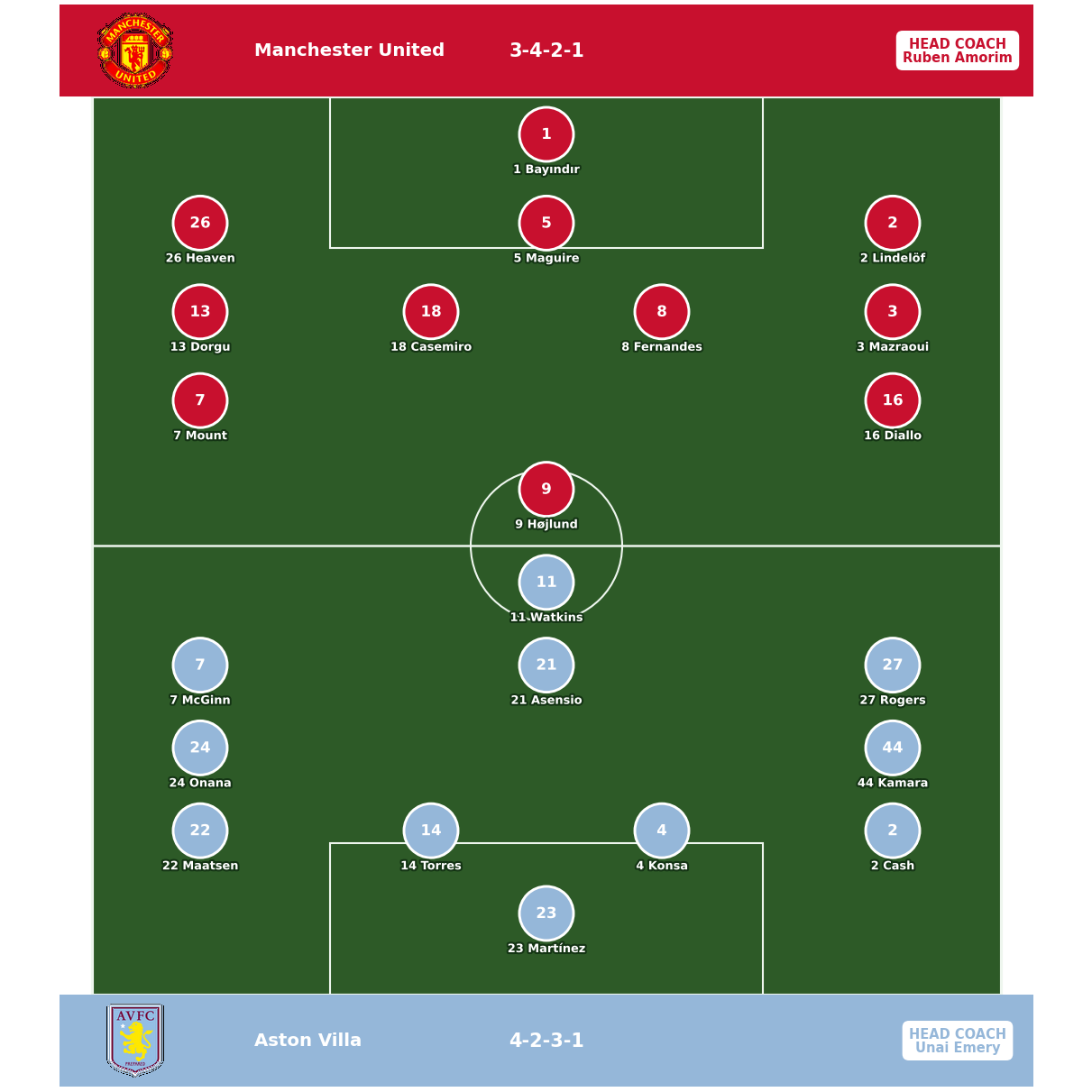
Amorim named a balanced 3-4-2-1 with Højlund leading the line, Amad Diallo and Mason Mount tucked in behind, and Bruno Fernandes anchoring the midfield alongside Casemiro. The early substitution of Mazraoui for Dalot at the 20-minute mark disrupted United’s rhythm on the right — a forced change that necessitated a further tactical shuffle at half-time when Mainoo replaced Dalot to stabilise the engine room.
Pre-red card, Villa were organised and reasonably compact. Their double pivot of Kamara and Onana looked comfortable absorbing United’s probing build-up, and Watkins — isolated but sharp — was at least a threat on the counter. Then Martínez panicked, and the contest fundamentally changed character.
In the second half, United’s 3-4-2-1 did what it always does: circulate possession, draw the opposition deep, find the half-spaces. Fernandes directed the tempo. Eriksen, introduced for Mount at the 66th minute, added composure and a late penalty (87′) to seal things. But for all the positional superiority — 300 passes fewer from Villa, 72% accuracy against United’s 88% — Amorim’s side produced the same meandering quality that has defined too many of their home performances.
The Statistics Tell a Complicated Story
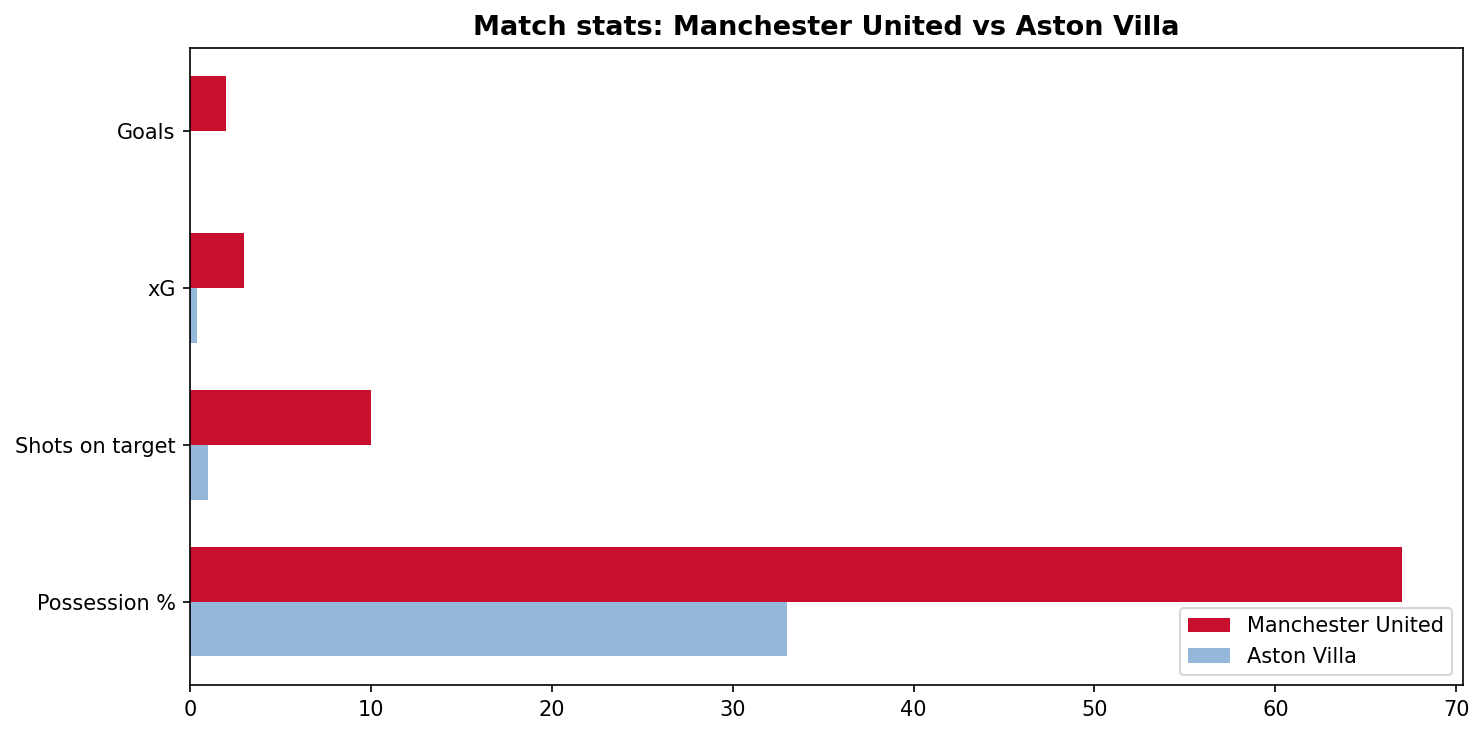
| Man United | Aston Villa | |
|---|---|---|
| Goals | 2 | 0 |
| xG | 2.95 | 0.39 |
| Possession | 67% | 33% |
| Total Shots | 25 | 6 |
| Shots on Target | 10 | 1 |
| GK Saves | 1 | 8 |
| Pass Accuracy | 88% | 72% |
Villa’s xG of 0.39 confirms the one-sided nature of the contest — Watkins and company were thoroughly neutered. But United’s own number cuts both ways: 2.95 xG converted into two goals, one of which came from the penalty spot. The underlying quality of chance creation was genuine; the execution, characteristically, was not.
Watch the Highlights
The extended highlights below recap the key moments from this match.
Bottom Line
Manchester United end their season with a win that flatters — and a performance that frustrates. With ten-man opposition, a back-up goalkeeper in goal, and complete statistical dominance, Amorim’s side should have been out of sight by the hour mark. Instead, they waited until the 76th minute, relied on Eriksen’s penalty, and gifted Olsen the platform for one of the saves tallies of the weekend. The xG was there. The intent was there. The ruthlessness was not — and that gap between structure and finishing power is the central question Amorim must answer next season.